
An “extra vertebra” or disc space near the base of the spine can be confusing. The important question is not just what the scan shows — it is how your spine is handling load.
At Perth Injury & Pain Clinic, we assess lumbarisation through a biomechanical, movement-based lens to understand whether it is relevant to your low back pain, flare-ups, or load sensitivity.
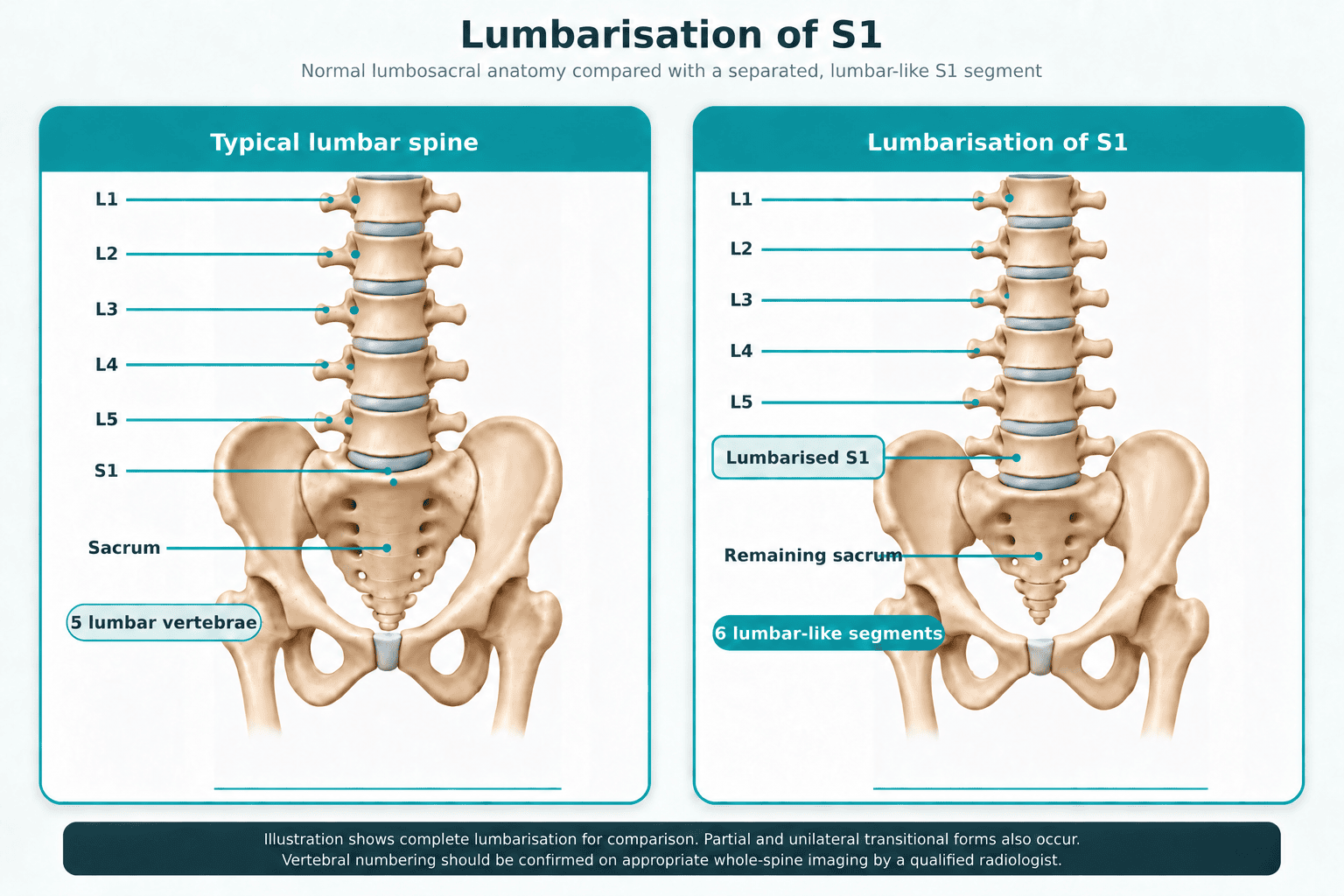
Lumbarisation is a type of lumbosacral transitional vertebra. Instead of the first sacral segment fully joining with the sacrum, it behaves more like an additional lumbar vertebra.
This may create an extra motion segment, an additional disc space, or a change in how force transfers between the lower spine and pelvis.
Most people with lumbarisation never know they have it. It is often found incidentally on X-ray, CT, or MRI.
Not always — but in the right mechanical context, it can contribute.
Lumbarisation is common and is not automatically painful. A scan finding alone does not explain everything.
Symptoms may appear when certain tissues become sensitive to repeated loading, compression, shear, extension, or rotation.
The key is identifying which movements and positions provoke symptoms, and how much load your spine currently tolerates.
Lumbarisation may alter how forces travel through the lumbosacral region. For some people, this can increase stress at adjacent spinal levels or create asymmetrical loading.
Pain close to the lumbosacral junction or one side of the lower back.
Symptoms after sitting, standing, or staying in one position too long.
Discomfort with twisting, turning, or asymmetrical loading.
Episodes that return when load, volume, or technique exceeds tolerance.
The label “lumbarisation” does not tell us what to fix. A detailed mechanical assessment helps identify the movements, postures, and loads that are actually driving symptoms.
Treatment is not about “correcting” the anatomy. It is about improving how your spine handles load and reducing unnecessary stress on sensitive tissues.
Modify repeated loaded flexion, prolonged static postures, irritating gym exercises, or movements that repeatedly trigger symptoms.
Build abdominal wall endurance, bracing skill, segmental control, and hip-driven movement to reduce excessive micro-movement.
Improve hip, pelvic, and thoracic contribution so the lower lumbar region is not forced to absorb every movement demand.
Surgery for lumbarisation is rare. In true Bertolotti’s Syndrome, diagnostic injections may help confirm a specific pain generator and surgical options may be considered. Most people, however, begin with targeted non-operative rehabilitation.
Lumbarisation is a structural variation. It is not automatically the cause of pain. But when combined with repeated mechanical stress, poor load tolerance, disc or endplate sensitivity, or asymmetrical shear, it may contribute to persistent low back pain.
People often describe it that way. More accurately, the first sacral segment behaves more like an additional lumbar segment instead of fully fusing with the sacrum.
No. Many people have lumbarisation without symptoms. Its relevance depends on how your spine functions, how it is loaded, and whether nearby tissues have become sensitised.
Yes, when it is matched to your pain triggers and load tolerance. The aim is not generic strengthening, but better movement strategy, trunk endurance, hip contribution, and graded exposure.
Bertolotti’s Syndrome refers to cases where a transitional vertebra is clinically linked to low back pain. Assessment is needed because the imaging finding alone is not enough to confirm the pain source.
If you have been told you have lumbarisation, a disc bulge, degeneration, endplate changes, or Bertolotti’s Syndrome — and still do not feel you have a clear mechanical explanation — we can help you understand what is driving your pain.
Selected references: